

Salt Awareness Week Report
.png)
What’s really in Britain’s favourite lunch? A new report by Action on Salt & Sugar has revealed worrying levels of hidden salt, fat and calories in many of the UK’s most popular sandwiches, a staple food eaten by millions every day.
Download: Sandwiches Report 2026 [PDF 7,725KB]
Download: Summary: Sandwiches Report 2026 [PDF 431KB]
The research, released during Salt Awareness Week (11-17th May), analysed 546 sandwiches sold across major supermarkets and high street chains. It found that while some businesses are producing healthier options, many sandwiches remain unnecessarily high in salt, with large differences between similar products and fillings. The findings show that making sandwiches healthier and with less salt is certainly possible, yet concerningly not always actioned.
Key findings
- 44% of sandwiches would receive a red ‘high’ salt warning under front‑of‑pack labelling guidelines.
- 1 in 4 sandwiches (25%) are classified as less healthy, meaning they would face restrictions on advertising and in‑store promotion.
- More than 1 in 10 (12%) sandwiches fail to meet government salt reduction targets that businesses were expected to meet two years ago, and 1 in 10 (10%) fail to meet calorie reduction targets .
Consequences on health
In the UK, adults currently consume 40% more salt than recommended, largely due to the high salt levels hidden in everyday foods – such as sandwiches, which are one of the leading contributors of salt in adults and children alike. Too much salt raises blood pressure, a leading cause of heart disease, stroke and kidney disease, and places immense and avoidable pressure on the NHS. With 11.5 billion sandwiches eaten in the UK every year, even small reductions in salt could have a major impact on population health. But, as the findings show, we cannot do it alone.
Environmental impact
The research also highlights wider concerns surrounding food system sustainability, due to the notable heavy reliance on meat‑based fillings, including processed meat. Three in four sandwiches contained meat or fish, while only 6% were plant-based, underlining the industry's continued dependence on salty, animal-based options. Processed meat not only has been shown to increase risk of cancer, but the industry’s large and continued reliance on industrial livestock production is also a leading contributor to greenhouse gas emissions, biodiversity loss and environmental degradation.
What’s the solution? 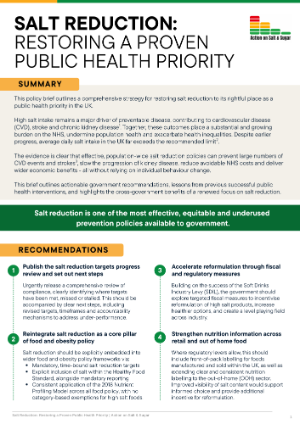
To protect physical, economical, and environmental health, Action on Salt & Sugar are urging government to:
- Urgently publish a long‑overdue review of progress against salt reduction targets
- Re‑establish salt reduction as a core public health priority within the Healthy Food Standard
- Introduce stronger, mandatory limits backed by accountability measures
- Fiscal levers for salt on food, to accelerate reformulation
- Improve transparency through clear nutrition labelling across retail and out of home
Download the Salt Reduction: Restoring a Proven Public Health Priority [PDF 510KB] policy brief for a further breakdown of this.
Sonia Pombo, Head of Research and Impact at Action on Salt & Sugar, based at Queen Mary University of London said:
“Most people choose sandwiches for lunch for their simplicity, convenience and affordability. But what they’re actually eating can be a full day’s worth of salt hidden between two slices of bread.
“More than 20 years after the first set of salt reduction targets were introduced, it’s frankly unacceptable that some companies continue to sell sandwiches that exceed an adult’s daily limit in one go. Voluntary action has been allowed to drift for too long, and the result is a food environment that continues to put public health at risk. The Government must now step in with tough, mandatory measures, because leaving this to industry goodwill has clearly failed.”
Dr Pauline Swift, Consultant Nephrologist and Chair of Action on Salt & Sugar added:
“Salt reduction is one of the quickest, cheapest and most effective ways to improve public health, yet progress has stalled. Too much salt drives up blood pressure, one of the biggest causes of preventable strokes, heart disease and kidney disease. People should not be exposed to a hidden health risk every time they buy lunch. Ministers need to stop relying on voluntary promises and start taking prevention more seriously.”
The report was launched in collaboration with Eating Better. Rebecca Sunter, Interim Executive Director of Eating Better quoted:
"This new report finds that far too many ready-to-eat sandwiches are still packed with unnecessary levels of salt, and with meat and dairy products that have been sourced from damaging industrialised livestock production systems. This means that on-the-go sandwiches are having large-scale detrimental environmental and health impacts both in the UK and abroad.
To address this, food retailers and food service operators can, and must, begin to source ingredients for sandwiches differently. The report shows just 6% of sandwiches surveyed were plant-based, highlighting a major opportunity for retailers to support healthier, more sustainable diets through reformulating their lunchtime offering and making healthy options both easy and affordable for consumers."
Dell Stanford, Senior Dietitian at British Heart Foundation, said:
“Most of the salt we eat is already in the food we buy, so we often end up eating more than we realise. This is a problem because too much salt can raise your blood pressure, which puts you at higher risk of a heart attack or stroke. We need Government to step in and incentivise manufacturers to take out excessive amounts of salt in our food.
“Meanwhile, this analysis shouldn’t put you off from enjoying a shop-bought sandwich occasionally, but there are ways to make your lunchtime staple healthier. Check the label and look for a sandwich with less salt and saturated fat, and ideally with lean protein and more fibre.”
Further details and a full breakdown of methodology can be found within the Sandwiches Report 2026 [PDF 7,725KB]
For comments or media enquiries, please contact David Clarke at david@rock-pr.com
